Forming…
CalBudget.
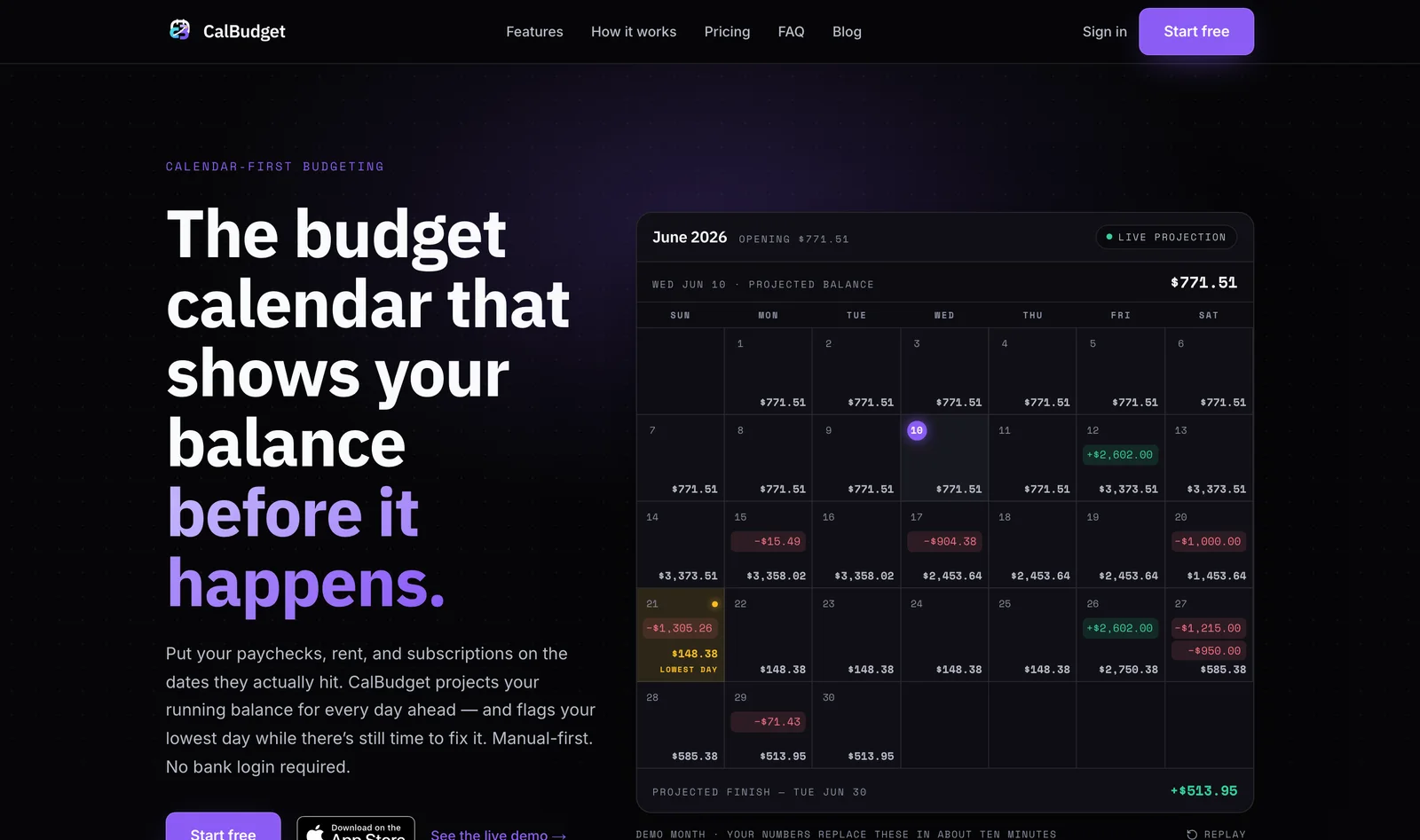
A personal budgeting product built around one question — not “where did my money go,” but “will I make it to the 26th?” Paychecks and bills land on the dates they actually hit, and every future day shows the balance you’ll have when you get there.
- SaaS platform
- Web / iOS / Mac / Windows
- 2026
- Live
- Product strategy / UX & UI design / Design system / Full-stack build / Cross-platform
Overview
CalBudget is a personal budgeting product built around a single, forward-looking question. Not “where did my money go?” — the question every other app already answers — but “will I make it to the 26th?”
Paychecks, rent, and subscriptions go on the dates they actually hit, and every day ahead shows the balance you’ll have when you get there. It ships on web, iOS, Mac, and Windows.
Live at calbudget.com — designed and built end to end.
The situation
Most budgeting apps are rearview mirrors. Categories, charts, month-end reports — all useful, all answering a question you’ve already lived through.
The anxiety they don’t touch is the forward-looking one: the gap between now and the next paycheck. And most of them demand a bank login before they’re useful at all — a real barrier for people who just want to plan.
The challenge
Make a forecast as legible as a calendar. A running projected balance for every future day is, underneath, just arithmetic — but showing up to two years of it without collapsing into a spreadsheet is the hard part.
It had to read identically across four platforms, and it had to earn trust without ever touching someone’s bank account.
What we did
Manual-first, calendar-first. The month is the interface: drop transactions onto the exact dates they’ll happen, and recurring series — daily through yearly, semimonthly included — fill the calendar automatically, up to two years out.
The lowest upcoming day is circled for you. Move one bill and the entire future recalculates — plan it, project it, protect it.
Experience & interface
Month, week, and day views with drag-and-drop transactions and a cleared toggle. Every future day carries its projected balance, and the lowest day ahead is flagged in the accent so the risk is visible on the 1st, not discovered on the 27th.
The visual language stays deliberately calm. This is a product people open when they’re anxious about money — it shouldn’t add to the noise.
Design system
A restrained system tuned for dense financial data: tabular figures everywhere, a clear transaction vocabulary, and one violet accent used only where it means something — the lowest day, the primary action.
The same components render across every platform, so the product feels like one thing whether it’s on a phone or a desktop.
Display / 36
Heading / 18
Body / 14 — reading text tuned for dense product surfaces, with tabular numerals where money or time appears.
12,480.00 → 08:45
ScheduledIn motionNeeds decisionComplete
One accent, rationed. Status never reads by color alone — icon, label, and weight repeat the message for everyone.
Technical shape
One product across web, iOS, Mac, and Windows, over a deterministic projection engine and a recurring-rules engine that expands series up to two years ahead.
CSV import turns any bank statement into a forward plan — no integration required. A debt-payoff planner (avalanche or snowball) and Sankey reports sit on the same timeline, and the Navigator AI layer reasons over the user’s actual forecast rather than dispensing generic advice.
Browser
Server-rendered UI
Application
Cross-platform clients
API layer
Typed, role-scoped
Systems
Projection engine · Recurring-rules engine · CSV import · AI over user data
Where it stands
CalBudget is live and shipping on every major platform, with tiered plans starting at free. It’s the clearest expression of a belief the studio keeps returning to: a budgeting tool should be a forecast you can act on, not a report of a month you can’t change.
Bring the rough idea; this is what taking it all the way to a shipped, cross-platform product looks like.